
Value My RV Before I Sell
Understand what affects your RV’s potential selling value before requesting an individual purchase review.
Buying RVs Since 2008
All 50 States
Free, No-Obligation Requests
Free Towing With Agreed Purchase
Detailed RV Evaluation
Name, phone number, ZIP code, RV type, year/make/model, and overall condition are required. Optional details include email, running status, motorhome mileage, known issues, additional RV details, and photos if secure uploads are configured.
Submitting this form asks RVBuyerUSA to contact you regarding your RV inquiry. It does not mean you have accepted an offer or agreed to a sale. Please read our Privacy Policy before submitting your information.
KNOW THE FACTORS
What Determines What Your RV Could Sell For?
Your RV’s model year is useful information, but it cannot tell the whole story.
A fifth wheel with a dry interior, working slide-outs, and documented maintenance may be in a very different position from the same model with soft flooring and unresolved leaks. Two Class C motorhomes may share a floorplan but differ in mileage, mechanical condition, and maintenance history.
Before settling on a selling price, look at the RV as a complete vehicle: what it is, what condition it is in today, what records are available, and what a potential buyer would need to know.
The RV’s identity
Make, model, year, size, floorplan, chassis, and original equipment help identify the correct vehicle for comparison. Differences in configuration can make similarly named models less comparable than they first appear.
Its present condition
The roof, walls, flooring, mechanical systems, appliances, plumbing, electrical equipment, and other components all contribute to a potential buyer’s assessment. Known defects should be described accurately, even when the cost of repairing them is uncertain.
Maintenance and documented history
Service records can help explain repairs, inspections, replacement components, and ongoing care. Documentation provides context, but it does not guarantee that the RV will receive a particular offer.
Location, ownership, and movement
An RV’s storage location, accessibility, title or lien status, and ability to move safely may influence whether a direct purchase is practical and what arrangements would be needed. Market conditions and demand can also differ by RV category, region, and time of year.
The important distinction: RV characteristics and condition help inform an assessment of value. Ownership and transportation circumstances can also affect whether a specific transaction is possible.
RVBuyerUSA reviews potential purchases individually. Completing an inquiry is not a guarantee that the RV will be approved or that an offer will be made.
VERIFY THE MODEL
Identify the Exact RV Before Comparing Prices
A useful comparison starts with the correct RV model.
Manufacturer brochures, registration documents, identification labels, and original purchase records can help establish its details. If the exact floorplan or model designation is unclear, provide the information you can verify instead of guessing.
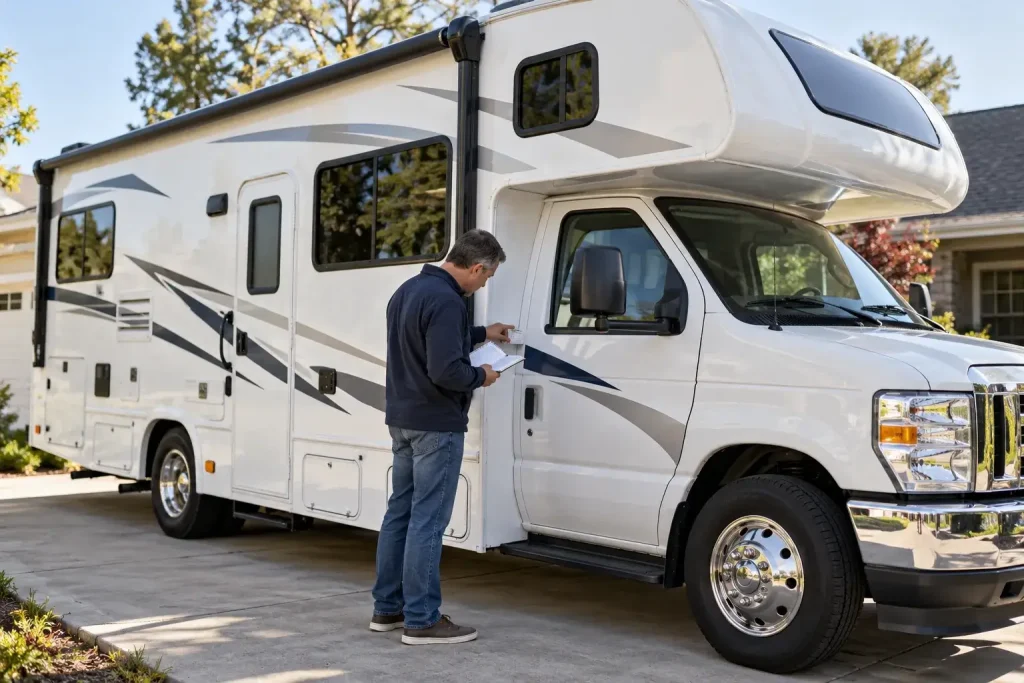
Details worth having ready
Motorhomes: identify the coach and chassis
For a Class A, Class B, or Class C motorhome, the coach manufacturer and the underlying chassis or drivetrain can both matter. Information worth collecting includes the model year, manufacturer, model designation, engine or chassis configuration when known, approximate odometer mileage, and whether the vehicle currently starts and drives. Also note equipment installed in the living area. A running engine does not establish that the roof, electrical equipment, plumbing, generator, or slide-outs are functioning correctly.
Travel trailers and fifth wheels: focus on the complete towable unit
Towable RVs require different comparisons. Record the manufacturer, model, length, floorplan, number of slide-outs, and identifiable equipment. Note any concerns involving the roof, frame, axles, tires, brakes, coupler, fifth-wheel hitch connection, or landing gear, as applicable. A travel trailer generally does not have an odometer. Its age and history must be considered through other available information.
Camper vans, toy haulers, and specialized RVs
Camper vans may have custom cabinetry, electrical installations, water systems, and other modifications. Toy haulers can have garage areas, loading ramps, and specialized equipment. Explain which features are original, modified, or known to have problems. The original cost of a modification does not automatically establish its resale value.
You do not need to take apart equipment, climb onto an unsafe roof, or operate a vehicle that may be unsafe to drive or tow simply to prepare an inquiry.
For general selling information, explore our nationwide RV selling guide.
ASSESS THE CONDITION
How Condition Changes the Value Picture
An RV can look well maintained from a distance while having problems that are difficult to identify in ordinary listing photographs.
The opposite is also possible: an older RV may show cosmetic wear but have records demonstrating that important systems have been repaired or maintained.
The goal is not to assign a perfect-condition label. It is to describe the RV in a way that a prospective buyer can understand.
Roof, walls, floors, and signs of moisture
Known roof leaks, damaged seals, soft flooring, staining, delamination, and previous water repairs are useful details. For example, a visible stain near a window does not establish how far any moisture damage extends. Describe the location, any repairs performed, and whether the problem is ongoing or has been addressed. Do not assume a hidden structural problem has been resolved merely because a visible surface has been repaired.
Engines, transmissions, and roadworthiness
For motorized RVs, explain whether the engine starts, whether the vehicle can currently be driven, and whether you know of problems with the transmission, brakes, steering, cooling system, or other important components. If a motorhome has not been started for several years, say so instead of describing it as running. For towable RVs, note known problems with tires, wheel bearings, axles, brakes, frame components, and towing connections. A trailer that can be attached to a vehicle is not necessarily safe to tow.
Interior systems and equipment
Heating, air conditioning, appliances, plumbing, generators, batteries, electrical equipment, and slide-outs can affect the overall picture. Separate functioning equipment from equipment that needs repair and equipment that has not recently been tested. An untested refrigerator is not the same as a confirmed working refrigerator.
Evidence from maintenance and storage
Maintenance receipts, previous repair invoices, photographs, and information about storage conditions can help explain the RV’s history. If a major repair was completed, provide the date or documentation when available. Do not describe undocumented work as professionally completed unless you know that to be true.
AS-IS EVALUATIONS
Damaged and non-running RVs
RVBuyerUSA also considers RVs affected by mechanical failure, water damage, physical damage, or non-running condition. A serious problem may affect potential purchase terms or eligibility, but it does not mean you must repair the RV before making an inquiry. Share what you know and identify what has not been tested. Each vehicle remains subject to an individual review.
PRICING RESEARCH
What RV Price Guides and Listings Leave Out
Published pricing information is useful for research, but no single number describes every selling situation.
The J.D. Power RV values resource provides information about used RV pricing, specifications, and RV categories. It can help you locate comparable models and understand published reference figures.
An actual RV may differ from those references because of equipment, maintenance, damage, use, location, and other circumstances. When researching your RV, pay attention to where each number comes from.
A price guide is a reference
A published value can help establish a starting point for research. It does not mean your particular RV has been inspected or that a buyer is committed to paying that amount. Check that you have selected the correct year, model, configuration, and relevant options.
An advertised price is a seller’s request
Online RV listings show what sellers are asking. They generally do not prove what the vehicles ultimately sell for. When using listings as comparisons, examine differences in condition, mileage, equipment, location, and advertised repair history. A listing that has remained active for a long time should not automatically be treated as evidence of an achievable selling price.
An actual offer has its own terms
A specific buyer may consider the RV’s condition, documentation, transportation needs, potential repairs, and the circumstances of a proposed transaction. The price offered may be different from a published guide figure or a private seller’s asking price. Before comparing offers, find out whether an amount is preliminary, whether an inspection or further verification is required, and which responsibilities are included.
Improve your comparisons
Rather than finding the highest advertised number, look for several reasonably similar RVs. Ask whether they have the same floorplan, comparable mileage where relevant, similar working equipment, and similar known condition. If critical details are missing, the listing may not be a strong comparison.
One number is rarely enough to make a selling decision. Use the information to understand your options, then assess the terms of any actual proposal.
RVBuyerUSA does not provide an instant certified appraisal through this form. It considers the specific RV for a potential direct purchase.
REPAIR OR SELL AS-IS
Is a Repair Worth Paying for Before You Sell?
Repairing an RV before selling can be sensible in some situations and uneconomical in others.
The main question is whether the likely benefit of the repair justifies the money, time, and uncertainty involved. An invoice for expensive work does not guarantee an equal increase in the selling price.

Start with work that makes the RV easier to assess
Basic cleaning, removing personal belongings, organizing service records, and identifying missing keys or manuals can help you present the vehicle accurately. Simple maintenance may also be reasonable when the cost and result are known. Keep receipts and avoid presenting ordinary preparation as a major restoration.
Separate minor defects from costly uncertainty
A small, well-understood maintenance issue is different from extensive water damage, a failed transmission, a damaged structural component, or an inoperative slide-out system. Major repairs may uncover additional problems. If you are considering them, obtain appropriate estimates before committing to the expense. Do not assume that repairing one visible problem will resolve every related issue.
Consider an as-is evaluation first
If the RV needs significant repairs, requesting a purchase review in its present condition gives you another option to consider. RVBuyerUSA evaluates damaged and non-running vehicles, although an individual purchase is never guaranteed. Describe the current condition, disclose known problems, and compare any actual proposal with the costs and uncertainty of repairing the RV before a different type of sale.
You do not need to make a repair commitment merely to submit an evaluation request.
SELLING ROUTES
Compare Selling Options Using the Same Assumptions
Different selling methods involve different amounts of work, uncertainty, and responsibility.
Comparing only the highest advertised price can lead to a misleading conclusion. Compare the actual terms available to you and account for your own expenses.
Private sale
With a private listing, you control the advertised price and communicate with prospective buyers. You may need to prepare photographs, answer questions, demonstrate the RV’s condition, arrange viewings, negotiate a price, and complete the applicable ownership-transfer requirements. A private sale can be a suitable choice when you are comfortable managing those steps. The advertised price is not guaranteed to become a completed sale.
Dealer trade-in
A dealership may consider your existing RV as part of another purchase. Evaluate the entire arrangement, including the replacement RV’s price, financing, trade-in allowance, and any applicable charges. A stated trade-in figure is not necessarily equivalent to receiving that amount as cash from a separate sale.
Consignment
A consignment business may help advertise or arrange a sale under its agreement. Before signing, examine commissions, storage costs, preparation charges, insurance responsibilities, pricing authority, and what happens if the RV does not sell. The ultimate result depends on the agreement and any completed transaction.
Direct purchase through RVBuyerUSA
RVBuyerUSA is a direct RV buyer rather than a public RV listing service. You submit information about the RV, it is considered individually, and a potential purchase offer may be discussed. You are free to decline an offer. If a purchase is agreed upon, free towing is included. No particular purchase amount, offer deadline, or transaction outcome is guaranteed.
Understand the difference between sale price and money received
If your RV has an outstanding loan, distinguish the vehicle’s agreed selling price from the money you would receive after settling the loan. For a financed RV, it helps to consider three separate items:
Agreed selling price
The amount the parties agree upon for the RV, subject to the applicable purchase terms.
Lender payoff
The amount required to settle the outstanding loan or lien. Confirm the current payoff with the lender rather than relying only on an older account statement.
Other applicable expenses
Any seller costs, taxes, charges, or adjustments that apply to the particular transaction and are not already included in the agreement.
An existing loan does not automatically reduce the RV’s physical value, but it can reduce the money remaining to you from a sale. If the payoff exceeds the agreed price, the difference must be addressed before the transaction can be completed.
Also consider your time, storage arrangements, repair expenses, and preferred level of involvement.
To learn more about nationwide selling options, visit Sell My RV.
GET A PERSONALIZED REVIEW
Request an Individual RV Purchase Review
Tell us about the RV you own, where it is located, and what condition it is in today.
The more accurately you can identify the vehicle and explain known problems, the easier it is to understand what needs to be evaluated.
You can submit an inquiry even if you do not know every detail. Explain what is uncertain rather than guessing.
RVBuyerUSA reviews RVs individually, and further information may be necessary before an offer can be considered. Not every RV will qualify for purchase.
Submitting a request is free and does not obligate you to sell.
WHAT HAPPENS NEXT
From RV Review to a Possible Purchase
An evaluation inquiry is one part of a potential RV sale. It is important to understand when a conversation becomes an actual transaction.
First, the RV information is considered
The year, make, model, condition, current location, and other details provide a starting point. Additional photographs, maintenance information, ownership details, or an inspection may be needed.
Next, you can consider any proposal
If an offer is possible, review the proposed amount and its conditions. Clarify whether anything remains subject to inspection or confirmation. You do not have to accept an offer.
If you agree, confirm the transaction arrangements
Before completing a sale, the parties must establish the applicable ownership documents, any lien-release requirements, payment arrangements, and pickup details. The specific responsibilities should be clear before documents are signed or the RV is released. Free towing is included with an agreed RV purchase. Pickup arrangements can depend on the RV’s condition, location, and accessibility.
For a more detailed explanation, read Our RV Buying Process.
To learn about the company’s nationwide purchasing approach and history since 2008, visit About RVBuyerUSA.
SELLER QUESTIONS
RV Valuation Questions Answered
For additional questions, see our RV Selling FAQ or contact RVBuyerUSA.
Ready to Explore Your RV’s Potential Selling Value?
You do not have to rely only on an advertised asking price or spend money repairing your RV before exploring another selling option.
RVBuyerUSA has been buying RVs since 2008 and considers purchase inquiries from owners across all 50 states.
Tell us what you own and describe its current condition. Your request is free, and any decision to sell remains yours.
Need clarification before completing the form? Contact RVBuyerUSA.